WHAT'S YOUR ROUTINE?

Every time you see a radical physical transformation, whether is be on TV, in a magazine, or with someone you know in real life, the same question comes out.

"What's your (their) routine?"

Everyone wants to know what the routine and diet was that resulted in this transformation.  What's the secret?  What is the magic formula?  How do you go from A to B?

The thing is, these questions ultimately miss the point.  They're based upon a false notion that it's all just a formula.  Plug in X amount of sets with Y amount of movements and you get Z results.

The reality is, it's not that easy.


Apparently this button didn't test well with the marketing demographic.

As much as we want everything in life to be binary and science, the reality is, physical transformation is art.  Science cannot capture the toil, the struggle, the hard work, sacrifice and pain.  Science is cold and unfeeling.  This is art.  Your physique and your ability are an expression of YOU.  Are you unstoppable?  Are you made of cold steel and nails?  Or are you soft, squishy, and possibly cream filled?


Sorry, I'm still not over them being gone.
The reality is, if you need to ask "how did you do it?", you won't be able to.  We like to over complicate this stuff and pretend like you HAVE to do a certain program a certain way at a certain time or else you won't get results, but the reality is, theses are just excuses.  Hard work is hard work.  The people who wake up one day and decide to change themselves through sheer physical toil and dedication get results, regardless of if they are following the "best" plan.  The people who follow P90X and then quit after a week don't, regardless of how well put together the plan is.

I have been called anti-intellectual in my ranting before, but lets address that.  The reality is, I see the human population as over educated these days, and as a result we are missing the "big picture".  We are a society of electrical engineers with no electricians.  All managers and no laborers.  We have lost sight of what it takes for success to happen.  A gameplan is fine and dandy, but without the sheer guts and willpower to forcibly affect change, it is worthless.  


Without the boots on the ground, this is just a man with a funny hat and a riding crop

Our lifting forefathers had none of the resources we have today.  There was no internet for Paul Anderson, Bob Peoples, Bill Kazmaier (in his prime of course), etc.  These men simply had to bust their ass and find out what worked through will power and bullheadedness.  It takes fortitude, mental and physical, to be able to keep returning to the gym and enforcing your will upon your body and the iron.  

From these men we can definitely learn lessons, and while some of them are intellectual (thank you Paul for the gift of ROM progression), the big one to learn is to just get in the gym and bust your ass.  

It's not about how many sets of how many reps of which movements you do on which day.  It's your ability to come back, again and again, and hit the iron hard enough to make an impression.

The Iron Guru Series: Gironda Shoulder Training Gems. By Vic Goyaram

The Iron Guru Series : Gironda Shoulder 
Training
 Researched and composed by Vic Goyaram
The One and Only "Iron Guru"

Many young bodybuilders may not know the Late Vince Gironda. Gironda is known as the "Iron Guru" having produced countless bodybuilding champions like Larry Scott, Don Howorthas well as trained several Hollywood stars like Clint Eastwood. Gironda's contribution to bodybuilding has been tremendous and what appeals to me particularly is the way he raised many eyebrows by questioning "established" practices in bodybuilding at that time. 

Indeed, some of his beliefs were controversial, namely his strong stance against shoulder presses, bench presses and squats. His ideas about low-carb and high-fat dieting are increasingly gaining scientific backing decades after he proposed them. We will get the opportunity to explore some of his ideas and philosophy in future articles.  In this article we will look at some of the Gironda shoulder training techniques that I have learned from reading his  books and articles.
Fig 1: Gironda with his famous pupil, Larry Scott (Left) and (right)
his other student, the 'Duke of Delts" Don Howorth. 
No shoulder pressing
Gironda was not a fan of shoulder pressing movements but rather advocated isolation movements like lateral raises for deltoid development.  There are, however, some press variations that he suggested, namely the Scott Press and the Bradford Press.

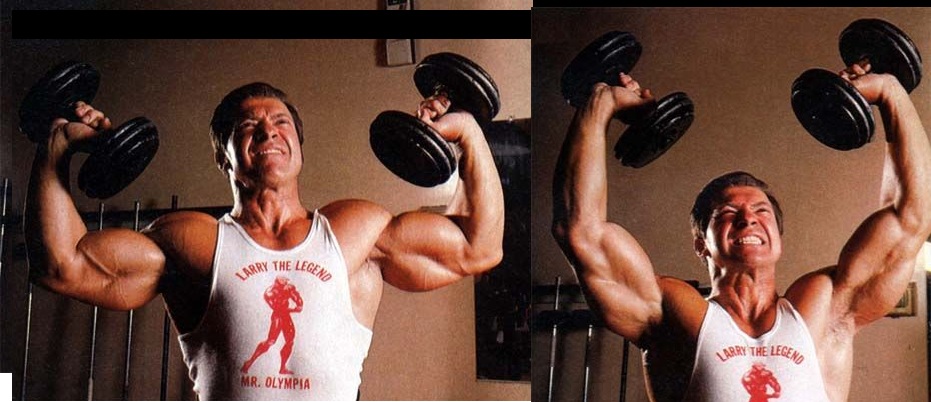
(a) The Scott dumbbell press
Larry Scott successfully used this exercise to bring up his deltoids to make up for his narrow structure. He maintained constant tension on the delts by not locking out at the top of the movement.
Fig 2: The Scott shoulder press
(b) The Bradford press
The Bradford press named after the lifter Jim Bradford is a modified version of a barbell press.  This exercise works the front and side deltoids and recruits the rear deltoids to some degree for stabilisation. Importantly, the weight need to be lower in this exercise (by about 10-20%) and  a slightly wider than shoulder grip is recommended. Start with the barbell resting on the collarbone as you would in a barbell millitary press. Then press the barbell until you reach just the top of the head, move the barbell over your hear and lower it behind your head until it touches the base of your neck. As a means of keeping constant tension on the delts the arms should never be extended completely. It is basically a back and forth movement with the barbell lifted just enough to clear the head. Do not move the head to make the movement easier, let the movement happen at the shoulder joint.  The video by T-Nation below demonstrates the proper Bradford Press technique.
The Gironda Lateral Raise technique
Gironda was very fond of the side lateral raise, an exercise that he recommended to perform either seated or standing. The seated lateral raise technique is illustrated in Figure 3 below and is as follows:
  • Sit at the end of a bench and maintain a slight forward lean. All four bells of both dumbbells should touch under the legs.
  • Raise the dumbbells while maintaining the slight forward bend position until the dumbbells reach head height. 
  • In this position the palms should be down and the knuckles up, meaning the rear bell should be higher than the forward bell, as if you are pouring water from a pitcher. This ensures that the lateral head does most of the work. Vince recommends 4 sets of 8-12 reps with about 30 seconds rest between sets.
  • The torso should not move throughout this exercise. Do not use the forward bent position as a means to use upper body momentum to help you lift heavy weights. I am sure that if you did this in Vince's gym the latter would have thrown you out of his gym.
    Fig 3: The seated lateral raise technique from the Vince Gironda Bulletin
    Fig 4: A custom-built equipment for maintaining a slight incline
    in standing side lateral raises. Gironda was known for his unique equipment
    Fig 5: The Iron Guru was always very attentive to form.
    Fig 6: Larry Scott demonstrating the side laterals
    Fig 7: Scott performing the seated version of the facing
    side lateral raise
    The Gironda dumbbell swings and high pulls
    The side swings is perhaps one of the best exercises to work several deltoid heads at the same time and a good means to prevent cheating.  Gironda's dumbbell swings work the side and anterior deltoids. To perform side swings, one arm moves in a traditional lateral raise motion while the other arm is moves up across the front of the body, tight to the torso, to keep continuous tension on the shoulder and help get a deeper contraction.
    Fig 8: Gironda performing the dumbbell swing and the high pull (described below)
    Barbell High pulls and upright rows.
    These two were Gironda's favourite exercises for the side deltoids.  Using a shoulder width grip recruits the side deltoid head to a greater degree. The execution of the High Pull is decribed in Fig 9. I believe there is a degree of trap involvement in this exercise. In the case of the barbell upright row the bar is kept closer to the body, as described in Fig 10.  Gironda credits the wide grip upright row/ pull component of cleans for the outstanding shoulders of weightlifters rather than the actual pressing movement.
    Fig 9: Gironda High Pull
    Fig 10: Execution guidelines for the Gironda barbell (wide grip) upright rows
    Tune in for more from in the "Iron Guru" series
    _______________________________________________________________________________

    ©,2013, Veeraj Goyaram, Bodybuilding Mauritius. Any reprinting in any type of media is prohibited.
    Disclaimer:
    The Content on this site is intended to be used for educational and entertainment purposes only. It is not intended to be and should not be interpreted as medical advice or a diagnosis of any health or fitness problem, condition or disease; or a recommendation for a specific test, doctor, care provider, procedure, treatment plan, product, or course of action. BODYBUILDING MAURITIUS is not a medical or healthcare provider and your use of this site does not create a doctor / patient relationship. We disclaim all responsibility for the professional qualifications and licensing of, and services provided by, any physician or other health providers posting on or otherwise referred to on this Site and/or any Third Party Site. Never disregard the medical advice of your physician or health professional, or delay in seeking such advice, because of something you read on this Site. We offer this Site AS IS and without any warranties.  Qualifications of author of article: Bachelor of Science (Honours) in Biology (Department of Biosciences, University of Mauritius) and Master of Science in Medicine in Exercise Molecular Biology/ Nutrition/ Type 2 diabetes (Research Unit for Exercise Science and Sports Medicine, University of Cape Town). Correspondence: vicgoyaram@gmail.com
    ________________________________________________________________________________


    YOU CAN'T WIN 'EM ALL


    In today's high speed culture, multitasking is a highly prized and sought after skill.  The advent of smart phones has made it so that at all times, we can be accomplishing another task, whether it be while driving, standing in line, or on the toilet.  Those who cannot multitask are viewed as slow, incompetent  weak and undesirable, whereas those that can aren't particularly rewarded for their ability, as it's become somewhat expected.  Yet, just like those people texting and driving, if you try to multitask when it comes to your training, you're just going to crash and burn.


    And you're probably an asshole, plus your blinker has been on for miles


    As appealing as it may be to be awesome at everything, you have to take a realistic look at yourself when it comes to training.  How great of an athlete are you?  Is it possible you have the genetic makeup to be great at many activities, or is it more probable that, if you have the capability to be great at all, it's only going to be at one thing?

    Go through your mental rolodex and think of how many athletes you know of that were ever at the professional level in two sports?  Right now, the only thing that comes to mind for me is Bo Jackson.


    Yes, I made a reference to Rolodex and Bo Jackson, I swear I am writing this in 2013


    On the other end of the spectrum, think about great athletes that have attempted to dabble in other sports, and the results that occurred.  As big of a fan as I am of Mariusz Pudzianowski, his foray into MMA demonstrated that he will need to undergo a vast amount of training to be able to compete at a reasonable level in his new sport.


    Don't get me wrong though.  I still wouldn't fight him


    Brian Siders, one of the strongest men in the world by powerlifting standards, had a very lackluster peformance in his World's Strongest Man debut as well.  And these are sports that value similar attributes in their respective athletes.  It gets even worse as you attempt to deviate to odder extremes.

    Think about it.  Professional athletes are genetic supermen that have trained their whole lives to excel athletically, yet these individuals still need to specialize.  Why is that?  Because very few people have the capacity to be great at many things, and the reality is, if you want to be great at anything, it's going to come at the expense of pursuing other physical goals.

    From a personal example, growing up, I wanted to be big and strong, and I also wanted to be a fighter.  In my mind, the two were equated, in that being big and strong would surely make me a great fighter, and being a great fighter would be the purest expression of strength.  In reality though, the goals contrasted.  My lifting would negatively impact my recovery from fight training, whereas my fight training would make me skinny from the energy I expended.  After years of training both goals, I was terrible at both of them.  Once I finally hung up the gloves and pursued strength training full time, my lifts took off, with me adding 140lbs to my deadlift and 30lbs to my bodyweight in a year.

    This isn't to say that you can't pursue multiple goals as an athlete, it just means you have to pick and choose the time to chase these goals.  If you try to train for powerlifting while engaging in boxing training and HIIT on your "off days", you're going to burn out quick and have no progress to show for it.  But if you periodize your training so that you have a phase where you are 100% dedicated to strength, then conditioning, then your sport, you will make massive gains in each endeavor.

    ZMA under the microscope. By Vic Goyaram

    ZMA under the Microscope:
    wonder supplement or just a Zinc formulation?
    Researched and composed by Vic Goyaram
    What is ZMA?
    ZMA stands for Zinc, Magnesium and Aspartate and is a patented formulation containing Zinc in the form of Zinc monomethionine/ Zinc aspartate, Magnesium aspartate and Vitamin B6 (Figure 1)
    Figure 1: Supplement facts of a ZMA supplement
    The monomethionine and aspartate are amino acids to which the minerals Zinc ad Magnesium are bound. This binding is called "chelation" and Zinc aspartate is called a "Zinc amino acid chelate". This is a term that you will encounter very often in supplement labels, especially for mineral supplement. Chelation is simply a procedure to improve the absorption and availability of the mineral.

    Zinc and Testosterone levels
    ZMA, as most of you already know, is sold as a testosterone booster supplement either by itself or as part of formulations of products marketed as testosterone boosters (Figure2).  ZMA capitalises on the known link between deficiency of dietary zinc and reduced testosterone levels. This link was first established in the early 60s by Prasad et al. (1963) whereby people with deficiency of Zinc were found to have low testosterone levels.  Later it became known that Zinc deficiency impairs the production of testosterone by reducing the action of important signals in testosterone production like Luteinizing hormone, follicle stimulating hormone and gonadotropin-releasing hormone.
    Figure 2: ZMA is marketed as a testosterone booster supplement (A)  either
    by itself in ZMA-only products or product formulations (B)containing 
    other ingredients that are supposed to increase testosterone production
    ZMA came into limelight in the year 2000 at the same time that a study by Brilla and Conte (2000) showed that semi-professional athletes that consumed ZMA experienced a 30% increase in testosterone and an accompanying increase in muscle strength compared to the athletes who did not take any ZMA. As a side-note, this study compared ZMA to a placebo rather than also including another group that supplemented with another zinc formulation in order to see whether ZMA is superior to any other zinc formulation. 

    It must be noted that one of the two authors of this article, (Victor) Conte (Figure 3) is the founder of BALCO Labs of steroid scandal fame. Conte also owns SNAC systems, a company which commercialises ZMA. Therefore he had interests in proving that his stuff does indeed increase testosterone.
    Figure 3: Victor Conte of BALCO labs fame with his flagship product, ZMA 
    Failure of ZMA to increase testosterone levels
    Unfortunately, many studies conducted afterwards using ZMA did not find any increase in testosterone. For example, a study by Wilborn et al. (2004) tested ZMA in resistance-trained males aged between 27-28 for 8 weeks. ZMA supplementation increased blood zinc levels by 11-17%.  However, they did not find any significant difference between the levels of anabolic and catabolic hormones, strength, endurance and anaerobic capacity.  

    Another study was conducted by German researchers (Koehler et al., 2009) in actively exercising men aged 22-33 yrs who are already consuming enough zinc on a daily basis (11.9-23.2mg/day) within the RDA range (9-11mg). They found no change in serum total and free testosterone with ZMA supplementation, suggesting that ZMA has no significant effects regarding serum testosterone in people who consume a zinc-sufficient diet.

    So what's the problem with ZMA? Personally, I believe that Zinc supplementation is of value under certain conditions (see the next section) and there definitely is a link between zinc status and testosterone. But I believe that ZMA started as a lie, a classic example of twisting knowledge and making a farce out of science in order to push a simple blend of minerals. That's just my personal opinion. I've also read from reliable sources that Victor Conte is all about steroids and is not to be trusted. He is not a scientist but a guitarist, with no formal scientific education. Some say that the ZMA used in the scientific study contained an oral steroid, something quite unlikely as testosterone values didn't skyrocket at the end of the experiment. Others say that he paid Dr. Brilla, a renowned researcher in Magnesium who co-authored the paper with him.  What I know for sure is that they claim to have published their results in the esteemed journal Medicine and Science in Sports and Exercise when in fact they published in the JEP Online website (JEPOnline, 3(4): 26-36).  Rumour has it that the athletes that Conte gave designer steroids to athletes like Marion Jones in exchange of them endorsing and singing praises to his ZMA blend.

    Is Zinc supplementation of any help then?
    The answer is yes but only under conditions of Zinc deficiency which is something that is not difficult to develop. Zinc deficiency not only impairs testosterone production but also leads to problems like growth abnormalities, mental lethargy, delayed would healing and impaired activities of zinc-dependent enzymes which play very important roles in the body. Under these conditions zinc supplementation have been reported to increase testosterone production.

    What bring about zinc deficiency are factors like:

    • High phytate content of the diet. Phytate is present in the hull of seeds, nuts and grains. It is indigestible and is able to complex minerals, namely Iron and Zinc which are then not available for absorption. My undergraduate degree  dissertation was in the field of human mineral nutrition (details in reference section) and I looked extensively at the disadvantages of diets rich in phytates that may lead to mineral deficiency.
    • Alcoholism, leading to urinary zinc excretion.
    • Liver and renal disease.
    • Exercise?
    Exercising individuals are at great risk of developing zinc deficiency as plasma zinc levels have been shown to decline with acute stress such as exercise (Volpe, 2012) thereby creating a need for ensuring adequate zinc intakes. Food sources are excellent for this (Figure 4). In a study conducted in wrestlers it was found that exhaustion exercise led to a significant reduction of zinc levels which led to decreased testosterone and thyroid hormones. However, a 4-week zinc supplementation program rescued this effect (Kilic et al., 2006). Therefore, zinc supplementation increases testosterone if you are deficient in zinc.

    However, even if you are actively exercising taking extra zinc when you are already getting sufficient amounts in the diet will be of no further help (Koehler et al., 2009).  You must turn to food rather than jumping blindly on supplement mega-doses because taking too much zinc potentially has a urinary alkalising effect as well as a diuretic effect and can negatively impact on the absorption of other minerals (competitive mineral absorption)
    Figure 3: some good dietary sources of Zinc (Volpe et al., 2012)
    ZMA and sleep quality
    There are many anecdotal reports that intake of ZMA and Zinc-Magnesium formulations help improve sleep quality.  Studies also found that zinc and magnesium supplementation improves sleep quality although these studies did not use ZMA (Rondanelli et al., 2011). 

    The take-home message
    • Zinc is important for many body function and a deficiency of zinc can lead to, among others, low testosterone levels.
    • Athletes can develop zinc deficiency and must consume foods that provide zinc.
    • ZMA has not been proven to increase testosterone. Likewise zinc supplementation is not proven to increase testosterone further when zinc intakes were already adequate.
    • You can obtain zinc from food sources and cheaper supplemental sources (e.g Zinc gluconate) rather than the patented, and therefore expensive, ZMA.
    • If you have money, buy ZMA. But remember taking extra zinc if testosterone levels and zinc intake are normal will not lead to higher testosterone. There are tests that can be done to check whether you are zinc deficient. 
    For daily discussions on bodybuilding (training, athletes, nutrition) visit our Facebook page

    References

    1. Brilla LR, Conte V (2000). Effects of a novel zinc–magnesium formulation on hormones and strength. JEPonline 3, 26–35.

    2. Kilic M, Baltaci AK, Gunay M, Gökbel H, Okudan N, Cicioglu I. The effect of exhaustion exercise on thyroid hormones and testosterone levels of elite athletes receiving oral zinc. Neuro Endocrinol Lett. 2006 Feb-Apr;27(1-2):247-52.

    3. Koehler K, Parr MK, Geyer H, Mester J, Schänzer W.Serum testosterone and urinary excretion of steroid hormone metabolites after administration of a high-dose zinc supplement. Eur J Clin Nutr. 2009 Jan;63(1):65-70.

    4. Prasad AS, Miale A, Farid Z, Schulert A, Sandstead HH (1963). Zinc metabolism in patients with the syndrome of iron deficiency anemia, hypogonadism and dwarfism. J Lab Clin Med 61, 537–549

    5. Rondanelli M, Opizzi A, Monteferrario F, Antoniello N, Manni R, Klersy C.The effect of melatonin, magnesium, and zinc on primary insomnia in long-term care facility residents in Italy: a double-blind, placebo-controlled clinical trial. J Am Geriatr Soc. 2011 Jan;59(1):82-90.

    6. Volpe, Stella Lucia. Minerals as Ergogenic Aids. Current Sports Medicine Reports. 7(4):224-229, July/August 2008.

    7. Wilborn CD, Kerksick CM, Campbell BI, Taylor LW, Marcello BM, Rasmussen CJ, Greenwood MC, Almada A, Kreider RB. Effects of Zinc Magnesium Aspartate (ZMA) Supplementation on Training Adaptations and Markers of Anabolism and Catabolism. J Int Soc Sports Nutr. 2004 Dec 31;1(2):12-20.
    _______________________________________________________________________________
    ©,2013, Veeraj Goyaram, Bodybuilding Mauritius. Any reprinting in any type of media is prohibited.
    Disclaimer:
    The Content on this site is intended to be used for educational and entertainment purposes only. It is not intended to be and should not be interpreted as medical advice or a diagnosis of any health or fitness problem, condition or disease; or a recommendation for a specific test, doctor, care provider, procedure, treatment plan, product, or course of action. BODYBUILDING MAURITIUS is not a medical or healthcare provider and your use of this site does not create a doctor / patient relationship. We disclaim all responsibility for the professional qualifications and licensing of, and services provided by, any physician or other health providers posting on or otherwise referred to on this Site and/or any Third Party Site. Never disregard the medical advice of your physician or health professional, or delay in seeking such advice, because of something you read on this Site. We offer this Site AS IS and without any warranties.  Qualifications of author of article: Bachelor of Science (Honours) in Biology (Department of Biosciences, University of Mauritius) and Master of Science in Medicine by research in Exercise Molecular Biology (Research Unit for Exercise Science and Sports Medicine, University of Cape Town). Correspondence: vicgoyaram@gmail.com
    ________________________________________________________________________________

    Whey protein, BCAAs, Glutamine: How to invest the money? By Vic Goyaram

    Whey protein, BCAAs,  Glutamine: 
    How to invest the money?
    Researched and Composed by Vic Goyaram
    Exclusive for Bodybuilding Mauritius
    Rationale of this article
    I have very often received questions from people willing to start supplementing with protein but are confused about what to choose among Whey protein, BCAAs and Glutamine. This is because for some the differences among these products are still confusing and the reasons for this are as follows:
    • Some supplement labels are somewhat confusing to the layperson. Too much scientific jargon used as a marketing tool in an attempt to sound impressive to the consumer.
    • Commonly terminologies like "anti-catabolic", "anabolic" and "promote muscle recovery" are used on the labels, leading people to believe that these products can be used interchangeably (Fig. 1).
    This article attempts to clear any possible confusion, explain the differences among these products and serve as a guide for how to spend your money.
    Fig. 1: Supplement labels are sometimes confusing. Glutamine and BCAAs
    are labelled as "recovery" supplements, leading people to believe that
    they can drink use either BCAAs or Glutamine  as a recovery supplement
    Whey protein
    For a detailed description of whey protein, the reader is referred to our whey protein article (link coming soon). Whey protein is basically a collection of several proteins that are called whey microfractions. As you probably already know, proteins are chains of units called amino acids. Therefore, whey protein is a collection of several chains of amino acids (microfractions). When your body digests these proteins under the action of proteolytic enzymes, amino acids are released. These amino acids are then used by body tissues (not only muscles) for making proteins by the process of protein synthesis.

    Whey protein provides the whole assortment of amino acids necessary for body protein synthesis, namely essential amino acids (those that they body cannot produce and must necessarily come from the diet) as well as non-essential amino acids. In addition, Whey protein is rich in Glutamine and the three Branched Chain amino acids (Leucine, Isoleucine and Valine) as shown in Fig. 2 below.
    Fig. 2. The Essential Amino acids profile whey proteins and other commercially available proteins per 100g of product. 
    (Graph acknowledgement: Suppversity Blog Click here to visit)
    Peptide-bonded v/s free form amino acids
    Glutamine and BCAAs in whey protein are peptide-bonded amino acids, meaning they are part of the amino acid chains that make up the protein (Fig. 3). When ingested, these need to be broken down by digestive enzymes to release these amino acids. Peptide-bonded amino acids therefore take more time before they can appear in the bloodstream. Of course various proteins differ in the speed at which they are digested to release amino acids. 

    On the other hand, Glutamine and BCAA supplements contain amino acids in the free form. The body does not need to break down any protein to obtain these amino acids. They are rapidly available to be absorbed and this appear in the bloodstream quicker. Similarly, amino acid supplements that provide the full spectrum of amino acids (Fig. 4) also contain free-form amino acids. 
    Fig. 3. Intact proteins in whey contain amino acids that are peptide-bonded, that is, part of a protein chain. Your body needs to digest the protein to liberate the amino acids
    Fig. 4. Amino acid supplements contain free-form amino acids.
    Your investment guide
    Now that you are equipped with a basic knowledge of protein and amino acid supplements, consider the following scenarios:

    Case A: A case for buying whey protein: If you struggle to obtain enough protein  
    As we know, ensuring an adequate intake of protein is fairly expensive from both food and supplemental sources. It is very likely that many persons reading this are not able to meet their protein needs. Our priority should be to ensure protein intake to the best of our ability (of course, without neglecting other macro-nutrients). This must dictate where our money should be spent on: on solid food sources of protein, followed by supplements to top it off.  I always advise to prioritise food sources of protein like chicken, meat, fish and eggs before worrying about flashy whey protein supplements although whey protein does have its importance.

    Therefore, if you are unable to get enough proteins you aren't going anywhere by taking  only BCAAs and Glutamine. These, particularly the BCAAs, are important amino acids that are involved in the recovery process but they are not sufficient for protein synthesis in the absence of sufficient amounts of the whole spectrum of amino acids. As I posted  recently, some people having read that BCAAs promote muscle recovery are resorting to drinking only BCAAs after workouts, much to the neglect of their need to get all the other amino acids from other sources. This practice is fine as long as you drink some form of fast carbs after workout and follow it with a meal containing protein a bit later. 

    Do this: After looking into your diet, make sure you are getting enough protein from food sources at regular intervals throughout the day. Do not buy whey protein with the aim of replacing meals or thinking you will get away skipping meals by drinking it. Then invest in a protein supplement which may be whey or a protein blend. If you think you are not eating enough protein and want to supplement do not go and spend your money on Glutamine and BCAAs, invest it in a protein supplement.

    Fig 5.Glutamine supplementation may have recovery benefits but it does not mean that you drink only Glutamine after workouts.

    Case B: You want to get the benefits of free-form BCAAs and Glutamine
    Assuming that you can ensure adequate protein through a combination of food and protein supplements, there may be added benefits of using BCAAs and Glutamine as follows:

    BCAA supplementation during cutting: 
    BCAAs are critical during cutting phases because you'll be eating less carbohydrates and thus have low muscle glycogen levels, the preferred energy source for bodybuilding workouts. Training on low muscle glycogen favours the breakdown of muscle protein in order to obtain amino acids for energy. The BCAAs are the amino acids that are used up the most, in particular Leucine. In this case, supplementation with free form BCAAs is warranted as a means of minimising protein breakdown and muscle tissue loss. Furthermore, during a cutting phase protein intake is increased in order to make up for decrements in carbohydrate intake and as a means of sparing muscle protein for use as energy.  Keep in mind that BCAAs do trigger an insulin response that you may think is counter-productive during a cutting phase because the release of insulin is supposed to bring fat burning to a grinding halt. However, the nature of the insulin release triggered by Leucine v/s carbs is different. There is only a single insulin response to an intake of BCAAs while carbs trigger a longer-term release of insulin. Therefore, BCAAs have more benefits than drawbacks to a bodybuilder on a cutting phase because it helps in muscle retention.

    BCAA supplementation during mass training?
    During a mass gaining phase energy provision is generally adequate, muscle glycogen is filled to capacity to fuel workouts and the risk of using muscle protein as fuel is lower. You can get away with not using a BCAA supplement in the presence of adequate protein intake and supplementation with whole proteins like whey protein which provide BCAAs already. 

    However, there is increasing data from research showing that the BCAAs, particularly Leucine, can trigger anabolic signals inside your muscle cells and thus switching on muscle protein synthesis (Fig 6). Such findings warranted the development of supplement protocols that included supplementing with free form BCAAs in between meals in order to keep the "anabolic switch on". A dosing protocol is 5g BCAAs between meals that are spaced about 3-4hrs in between. However, keep in mind that switching on anabolism is meaningful only in the presence of adequate supplies of all the other amino acids.  There is a lot of interesting data on BCAAs which will be the topic of another article. A good protocol for BCAA intake is 5g morning, 5g preworkout, 10g postworkout and 5g at bedtime as recommended by Dr. Layne Norton who is an authority on BCAAs and muscle protein synthesis.  The above benefit of keeping the anabolic switch on relates to rapid rises to BCAA levels in blood that would follow BCAA supplementation in the free form. Whey and other proteins do contain BCAAs but these are released at a slower rate than those from free-form supplements. A rapid rise in blood amino acid levels (aminoacidemia) is needed for this particular effect. 

    However, while the proposed mechanism by which BCAA triggers the anabolic switch has been elegantly laid out, it remains to be seen whether there is a long term effect in terms of lean body mass gain in humans. In other words, whether taking free form BCAAs in addition to the BCAAs you are getting from whole-protein foods/ supplements is giving you any extra muscle. Future articles will be devoted to particular aspects of BCAAs.
      Fig. 6. Leucine activates the important anabolic switch "mTOR",
       providing a basis of Leucine supplementation in the free form
      Glutamine supplementation
      Glutamine supplementation may be important to the athlete as it is involved in a number of functions like ammonia scavenging  muscle protein synthesis, glycogen synthesis and immune functions. Based on glutamine's involvement in important physiological processes  we cannot extrapolate and say that taking extra glutamine will give additional benefits.  There is no evidence that glutamine supplementation even in the long term has a significant effect on muscle performance, muscle protein degradation and body composition in young healthy adults as found in a study by Candow et al. (2001).

      Remember that glutamine is a non-essential amino acid, meaning that it can be synthesised by the body from essential amino acids, particularly the BCAAs. With this in mind, a well fed body is well able to meet its daily glutamine demands even under stressful exercise. Your aim should be to ensure an adequate supply of essential amino acids from food sources and should you be taking whey protein then your glutamine needs would be easily covered. Future articles will deal with aspects of glutamine (research, its other functions and "benefits" and supplementation rationale).  

      The take-home lesson
      Your whole proteins are very important because they provide the whole assortment of amino acids. Maintaining adequate intake of the same should be your main priority. BCAAs are supplements with great merit in both bodybuilding and other competitive sports and their use in the free amino acid form is warranted in pre-contest training as well as mass training, as recent data suggest. However, the use of BCAAs will only be meaningful in the presence of sufficient proteins that provide the full amino acid spectrum for protein synthesis. Finally, if you are someone struggling with protein intake from food and want to supplement then invest in a good whey protein before considering BCAA or glutamine. Finally, there is no evidence that glutamine supplementation will lead to increased muscle mass should all your essential amino acids be met by food or a whey supplement. Glutamine may have other benefits.

      References
      Candow DG, Chilibeck PD, Burke DG, Davison KS, Smith-Palmer T: Effect of glutamine supplementation combined with resistance training in young adults. Eur J Appl Physiol 2001, 86(2):142-9

      ________________________________________________________________________________
      ©,2013, Veeraj Goyaram, Bodybuilding Mauritius. Any reprinting in any type of media is prohibited.

      Disclaimer:
      The Content on this site is intended to be used for educational and entertainment purposes only. It is not intended to be and should not be interpreted as medical advice or a diagnosis of any health or fitness problem, condition or disease; or a recommendation for a specific test, doctor, care provider, procedure, treatment plan, product, or course of action. BODYBUILDING MAURITIUS is not a medical or healthcare provider and your use of this site does not create a doctor / patient relationship. We disclaim all responsibility for the professional qualifications and licensing of, and services provided by, any physician or other health providers posting on or otherwise referred to on this Site and/or any Third Party Site. Never disregard the medical advice of your physician or health professional, or delay in seeking such advice, because of something you read on this Site. We offer this Site AS IS and without any warranties.  Qualifications of author of article: Bachelor of Science (Honours) in Biology (Department of Biosciences, University of Mauritius) and Master of Science in Medicine by research in Exercise Molecular Biology (Research Unit for Exercise Science and Sports Medicine, University of Cape Town). Correspondence: vicgoyaram@gmail.com
      ________________________________________________________________________________

      Glucosamine supplements: a critical evaluation. By Vic Goyaram


      A critical evaluation of Glucosamine-based Joint supplements
      Researched and composed by Vic Goyaram

      Introduction
      Glucosamine is a very popular ingredient in supplements meant for patients of osteoarthritis as well as people engaged in sports and physical exercise for the maintenance of healthy joints and joint regeneration.  Most joint supplements are based on Glucosamine which is purported to help to support the structure and function of joints because it is a substrate for the biosynthesis of glycosaminoglycan (GAG), the building blocks of joints (Fallon, 2001). Glucosamine exists under several forms in supplements, namely Glucosamine hydrochloride, N-Acetylglucosamine and the most popular chemical form Glucosamine sulphate. The latter form is the most studied scientifically. Glucosamine by itself accounted for USD 720 million in terms of sales in 2005. This article attempts to review key aspects of glucosamine supplementation, including a discussion of the evidence for and against its effectiveness in joint healing.

      Glucosamine product formulations and dosages
      Most joint products contain glucosamine either as Glucosamine sulphate by itself or with added Chondroitin and MSM (Figure 1).  However, although these different forms of glucosamine may be chemically related the effects may not be the same when taken as supplements for the purported benefits.  Sulphate is the form which has been used in most scientific studies on Glucosamine. Additionally, some joint product formulations will also include other ingredients like MSM, Bromelain and Collagen (Figure 2) which may be involved in joint support. These products may come in the form of tablets, capsules or powder although tablets remain the most common formulation, from personal observation.

      Figure 1: The most common glucosamine-based joint support
      product formulation containing MSM and Chondroitin
      Figure 2: Example of more advanced formulations containing 
      glucosamine and other ingredients. The effectiveness of such formulas
       will be subject of another article.
      The dosages vary from product to product but most contain about 1500-2000mg Glucosamine per recommended serving.

      Dosage and precautions
      Glucosamine is not recommended for children as it is mainly used to treat OA (a condition that affects adults) and its safety for children has not been studied. The recommended dosage for adults is 500 mg, 3 times daily, for 30 - 90 days. Once daily dosing as 1.5 g (1,500 mg) may also be used.Most studies show that glucosamine needs to be taken for 2 - 4 months before it is effective, although you may experience some improvement sooner. Glucosamine and chondroitin can be used along with nonsteroidal anti-inflammatory drugs (NSAIDs) to treat OA. Glucosamine must not be administered haphazardly because it can have interaction with or counteract the effect of some medications like Warfarin (Glucosamine may increase the blood thinning effect of warfarin), Nonsteroidal anti-inflammatory drugs (NSAIDs) (Glucosamine may reduce the need for NSAIDs), blood sugar lowering medications or insulin (Glucosamine may change the dose needed for blood sugar lowering medications and insulin).  Therefore it is always best to obtain medical clearance before commencing glucosamine treatment in the presence of existing medical conditions that necessitate the use of the above drugs.

      Evaluating the evidence for the effectiveness of Glucosamine

      The use of glucosamine is common among athletes at all ages and levels (Buckwalter 2003) but here is little if any evidence currently available about the claimed anti-inflammatory, analgesic, or protective effects of glucosamine in the athletic environment.  One study by Ostojica et al. (2007) studied the effect of 4 weeks of glucosamine administration (1500 mg per day) on the functional ability and the degree of pain intensity in competitive male athletes who had acute knee injury.  No significant difference was seen in pain intensity and knee swelling between the glucosamine and placebo group.  However, improvements in knee flexion and extension were noted thereby indicating that glucosamine may have an effect on joint mobility in injured states.

      Glucosamine has been studied in cases of osteoarthritis (OA). Osteoarthritis is a type of arthritis that occurs when cartilage breaks down and is lost, either due to injury or to normal wear and tear. It commonly occurs with age. In some studies, glucosamine supplements have:

      (a) decreased the joint pain of OA, 
      (b) improved function in people with hip or knee OA, 
      (c) reduced joint swelling and stiffness and 
      (d) provided relief from OA symptoms for up to 3 months after stopping treatment

      Not all studies are positive, however, and several more recent ones have not found any positive effect from taking glucosamine For example, in the large clinical trial by Sawitzke et al. (2008), called the 2006 Glucosamine/Chondroitin Arthritis Intervention Trial (GAIT), conflicting and somewhat confusing results. The study of about 1,600 people with OA of the knee found that glucosamine alone, or in combination with chondroitin did not reduce pain in the overall group, although it did appear to lessen pain among those with moderate to severe OA of the knee. This study has provided the impetus for further research. Studies are currently being conducted to see whether the glucosamine-chondroitin combination may in fact help those with more severe OA in an attempt to see whether any benefit is seen in more severe cases.  The study also tested whether glucosamine or chondroitin (together or alone) slowed the loss of cartilage in their knees. They showed no difference in cartilage loss compared with people who took placebo. In light of these conflicting findings, more research is warranted on Glucosamine before it can conclusively be said to be effective.

      References

      Buckwalter, JA. 2003. Sports, joint injury, and posttraumatic osteoarthritis. Journal of Orthopaedic and Sports Physical Therapy, 33: 578–588.

      Fallon K. Glucosamine in the management of osteoarthritis. Int SportsMed J. 2001; 2(4).
      Ostojica S.M, M. Arsicb, S. Prodanovicc, J. Vukovica & M. Zlatanovicd. Glucosamine Administration in Athletes: Effects on Recovery of Acute Knee Injury. Research in Sports Medicine: An International Journal. Volume 15, Issue 2, 2007. pages 113-124

      Sawitzke et al. The Effect of Glucosamine and/or Chondroitin Sulfate on the Progression of Knee Osteoarthritis: A GAIT Report. Arthritis Rheum. 2008 October; 58(10): 3183–3191

      ©,2013, Veeraj Goyaram, Bodybuilding Mauritius. Any reprinting in any type of media is prohibited.


      Disclaimer:
      The Content on this site is intended to be used for educational and entertainment purposes only. It is not intended to be and should not be interpreted as medical advice or a diagnosis of any health or fitness problem, condition or disease; or a recommendation for a specific test, doctor, care provider, procedure, treatment plan, product, or course of action. BODYBUILDING MAURITIUS is not a medical or healthcare provider and your use of this site does not create a doctor / patient relationship. We disclaim all responsibility for the professional qualifications and licensing of, and services provided by, any physician or other health providers posting on or otherwise referred to on this Site and/or any Third Party Site. Never disregard the medical advice of your physician or health professional, or delay in seeking such advice, because of something you read on this Site. We offer this Site AS IS and without any warranties.

      Glucosamine products pictured in this article are trademarks of NOW and Solgar.
      Related Posts Plugin for WordPress, Blogger...