Powerlifting training for bodybuilders. By John Bubb, former NABBA Pro bodybuilder

Powerlifting-type training for bodybuilding
By John Bubb, former NABBA pro bodybuilder
John Bubb on the legendary NABBA Universe stage
Introduction by Vic Goyaram

This article is for those willing to use powerlifting-type training to improve their strength and physique. Most people imagine big butts and waists when thinking of a power lifter’s physique. Incorrect! Improper diet is more to blame than powerlifting exercises and style of training. There are many great powerlifters who display envious physiques with virtually no bodybuilding training. One example is Vince Anello, the legendary US-based powerlifter. Likewise, most of us diehard fans know about bodybuilders with a powerlifting background and whose training borrows a lot from powerlifting. We all know about Johnny Jackson and Franco Columbu. The dangerous physique that John Bubb sported in his prime is also courtesy of his powerlifting background and his style of training. As usual, we are more than pleased to have John sharing his pearls of wisdom with us but before “leaving the floor” to our guru allow me to give you some basics on this topic.
Powerlifting legend Vince Anello was built like a
bodybuilder. He even did bodybuilding shows like Mr. America
IFBB Pro Johnny Jackson is a competitive powerlifter in the offseason.
When Bob Cicherillo announced Johnny "O" Jackson at the Olympia
you'll always see the thickest muscle in the pro league.
John Bubb's suggested plan for BULKING up
(12-week program)
John holding his own next to Reg Park and Arnold
The main trouble with giving out this type of advice is that I have no idea how long you have been training or how advanced you are. Obviously the type of exercise schedule that I’m going to advise would be far too advanced for somebody who had only been training for a few months. I’m going to assume that you’ve done at least a year.


If you want to put on size and get much stronger, you’ve got to forget you are a bodybuilder for 6 months and pretend you are a POWERLIFTER. Train for size and strength and then when you go back to pure bodybuilding you will be able to perform the conventional exercises with a lot more weight and thus make them more effective. Before I became a professional I used to enter power lifting contests quite regularly and the preparation for these contests used to really help my bodybuilding training. In fact I found that I gained size all over (even my arms) when I was literally only doing Bench Press, Squats and Dead Lifts. It thickens your muscularity or, gives you more muscle density.

If you do decide to follow this plan you will probably feel that you are not doing enough, but trust me, you will be. And remember, most bodybuilders over train. Especially beginners because they are over anxious to make progress. You grow while you are resting, not when you are pumping. Talking of resting, when you are doing power training you need nice long rests between sets. If you rush you won’t make the poundages so you will be diluting the effect.

Always warm-up with a little Cardio before you start.


The training program

Mondays and Thursdays (Chest, triceps, calves and abs)

First exercise: Bench Press – FLAT
Execution of the bench press
  • 1 set of 15, really silly light
  • 1 set of 8 using a weight with which you could get 10 if you were really trying. 
  • Add weight and do 1 set of 5 using a weight with which you could get 8 if you were really trying.
  • Add a little weight and perform 1 set of 5.
  • Add a little weight. 1 set of five flat out. Make sure you do get five.
  • Add a little weight. 1 set of five to failure. On this set you might only get three or four to start with, but that’s fine.
  • 1 set of five using the same weight as you used for the third set of five. This time do as many as you can. You’ll probably surprise yourself and get seven or eight. If you manage eight you can finish. If not do:-
  • 1 set of eight or ten using the same weight as you used for the first set of five.
After you’ve done this four or five times you should be able to add a little extra weight on all the sets of five. It’s particularly satisfying when you suddenly find you are getting five on that fourth set and you can add even more weight. You’re on the move and this is the first day of the rest of your life!!

Second exercise: Triceps Extensions lying on a bench (Head Crushers)
Execution of the skull crushers
1 set of ten quite light.
4 sets of eight heavy

Third exercise: Your favourite Calf Raises.5 sets of 15 to 20.
Click for full article on calf training

Fourth exercise: Abdominals
Finish up with 3 or 4 sets of abdominal exercises, that is crunches or leg raises. Don’t go mad. These are just to make sure that no part of your body gets left out.

Tuesdays and Fridays (Legs, Back, Biceps, calves)
First exercise: Conventional Squats.
Squat execution
  • 1 set of 20 really silly light, then:-
  • 1 set of eight – easy, then:-
  • 5 x 5 performed exactly as the Bench Press.
  • 1 set of as many as you can manage using the same weight as you used for the first set of five. Finish.
Second exercise: T-Bar Rowing
T-bar row execution
  • 1 set of eight - quite light
  • 4 sets of six – heavy
  • Bend your knees slightly and make sure you keep your back really flat throughout the complete movement.
Third exercise: Conventional Barbell Curls

Barbell curl execution
  • 1 set of 8 or 10 - fairly light.
  • 5 sets of 6 – heavy. Do these in a fairly loose style with just a little bit of heave and swing. DON’T overdo it however. Just enough heave to get the heavy weight moving.

Fourth exercise: Choose another Calf Raise (different from Monday & Thursday)

5 sets of 15 to 20.

Every third work-out (on the legs and back days) leave out Squats and do DEAD LIFTS as follows:-

  • 1 set of ten really light and easy.
  • 1 set of six a bit heavier, but well within your capability.
  • 1 set of four fairly heavy, but still not flat out.
  • 1 single rep – heavy.
  • Add a little weight. 1 single rep. 
  • Add a little weight. 1 single rep. 
  • Add a little weight. 1 single rep. 
  • Take off a little weight. 1 single rep. 

Drop the weight way down and do four or six to finish off. 

If you follow this recipe to the letter you will be amazed and thrilled at how quickly your poundages shoot up after a few workouts. And remember, there is nothing like Dead Lifts to thicken your back. giving you that muscle density you are looking for.


Do all of this for twelve weeks.
Regards,

John Bubb for Bodybuilding Mauritius
________________________________________________________________

About the Author
John Bubb is a former NABBA professional bodybuilder with more than half a century of experience in the iron game. John has six top four finishes at the NABBA Pro Mr. Universe from 1967 to 1971, including a runner-up placing to Arnold Schwarzenegger in 1968. 

John has trained several bodybuilders from many countries and has remained very active in the bodybuilding arena decades after hanging his posing trunks. He is one of our most prized contributors at Bodybuilding Mauritius and we feel very honoured to have someone of the calibre of John dispensing advice to all of us with such enthusiasm. 

We at Bodybuilding Mauritius are very keen about old-school bodybuilding as we believe that in order for bodybuilding to have a future it must look back at its past. We couldn't ask for a better guru of Golden era bodybuilding than "Iron Grandpa Bubb". 


ASSISTANCE EXERCISE VARIATIONS


I was stuck in a meeting at work and started charting out what sort of assistance exercises I could do for my bench press, thought I'd pass on my notes here to inspire others. If you have followed my training, you know I train in my garage, and everything I own has been personally funded, which means I don't have nearly the variety of equipment available to me that most people in a well stocked gym do. That said, I found I actually could do 2000 different variations of bench alone based on what I had.

Here is how I broke down the variables available to me in order to develop variations

Platform:
Flat bench
Incline bench
Floor (floor pressing)

Bar:
Barbell
Swiss bar
Dumbbell

Grips:
W/ fat gripz (for reference http://www.amazon.com/Fat-Gripz/dp/B005FIS14Y/ref=sr_1_1?ie=UTF8&qid=1354990664&sr=8-1&keywords=fat+gripz they also make an "extreme model" too if you want to open up your options)
W/o fat gripz

Grip width:
Normal
Close grip (BB/Swiss bar only)
Wide (BB/Swiss bar only)
Parallel (DB only)

Pause at bottom of movement:
Yes
No

Lockout reps at top:
Yes
No

Height of starting point:
No real way to put a number to this, you can go any number of inches/measurements off your chest (not applicable to floor press)

Method of height of starting point:
Chest (not applicable to floor press)
Chain suspended (BB/Swiss bar only) (not applicable to floor press)
Boards (BB/Swiss bar only) (not applicable to floor press)
Pins (BB/Swiss bar only) (not applicable to floor press)

Modifications to bar:
None
Chains
Reverse bands (BB/Swiss bar only)
Against bands


Basically, from here it's like chinese food. Just pick something from each column and you've built a bench variation to use.

One of the key things here is that some low cost/high effect things to get to increase your variability is some fat gripz and some resistance bands. Chains are awesome too, but not very portable.

That, and it doesn't take much to have a lot of variety available to you. Very minor modifications can result in almost totally new movements.

All about training the calves. By Vic Goyaram

All about training the Calves
Researched and Composed by Vic Goyaram
Introduction

In the history of resistance training calves hold the presidential position of the least trained muscles and perhaps the most inappropriately trained as well.  Over the last couple of months, how much attention have you given your calves compared to your arms and chest? We all wish to have 19" or 20" arms and find ways and means to go get them but how serious are we about developing calves? Calves top the neglect list for a variety of reasons: they are a pain in the you-know-where to train, they do not respond well to training in most people, they are pretty much covered most of the time except in summer (out of sight, out of mind) or you simply quit training them out of frustration over the absence of any noticeable progress. This article attempts to shed light on key aspects of calf training and development. We will address the genetic aspect of calf development, common calf training mistakes and provide some solutions. Without further ado, let us start.
-----------------------------------------------------------------------------------------------------------------------------------------------
Anatomy and genetics of calves

Calves are not only Gastrocnemius and Soleus 
The calves are very often anatomically described in most training articles as consisting of the soleus and the gastrocnemius. This is very incorrect as it fails to appraise calf muscles running in front of the tibia bone that has a lot of growth potential, contributes a lot to calf strength and the appearance and mass of the calves when looked from the front. These front calf muscles consists of the Peroneus, extensor digitorum with the tibialis anterior claiming the lion's share (Fig 1).  We will cover some exercises that hit the front calf muscles. 
Fig 1.: The anatomy of the calves. The calves are not made up
only of the soleus and gastrocnemius but also of front calf muscles
"Either you have them or you don't"
For no other body-part than calves does the saying "either you have them or you don't" holds true in bodybuilding.  Indeed, how your calves are built, its attachment and muscle fibre allocation are largely determined by genetics. Some people do not have much muscle cells to build on in the calves. One example is Dennis Wolf who has little muscle fibre allocation in his calves in comparison to Ben Pakulski (Fig 2).  In general, black Africans are less gifted in the calves department in the sense that they have very short calf muscles and long achilles tendon. Just compare the calves of Ronnie Coleman to that of Dorian Yates (Fig 3) and you will notice the massive difference in the length of the gastrocnemius. This "high calves curse" as it is sometimes called is an advantage as far as speed is concerned but a massive disadvantage when it comes to developing massive and full calves (Fig.4). Exceptions to this rule are guys like Chris Dickerson and Sergio Oliva who both owned massive pairs of calves.
Fig 2: Dennis Wolf (left) has both high calves and fewer muscle
fibres than Ben Pakulski (right) in his calves. 
Fig 3: Ronnie has high calves while Dorian has full calves that
attach very low.
Fig 4: Black Africans generally have high and
skinny calves, a massive advantage for sprinting.
Can we blame genetics alone for poor calves?
Bad genetics have too often taken the blame for poor calves but the problem in my opinion is that calves are inadequately trained. By inadequately I mean that calves either don't get enough training sessions or are not trained with the same intensity as arms and chest for example. This is indeed true as how many people do you see training calves in your gym everyday? Very few. The fact that most gyms are equipped with numerous benches and fewer squat racks and calf stations reflect this reality. 

Bad genetics is an important factor but I am sure that some of you have overcome bad arm or chest genetics with intense workouts to slap new mass onto your arms and chest. The same can be done for the calves. No matter what your genetics you can train hard to improve your calves.  You must strive to get your calves as big as your arms. For instance Steve Reeves (Fig 5) had both arms and calves stretching the tape at 17.5".  
Fig 5: Symmetrical development. Reeves' calves were the same
size as his legs. Trey Brewer's quads that are out of
proportion to his calves. 
How to attack the calves?
While most people are content with throwing a couple of sets of calf raises at the end of their leg workout we are here for some real progress. Training calves are indeed painful because of an abundance of nerve endings there but you must learn to love the excruciating pain.  In this section I will provide some essential pointers as well as a sample routine that has worked wonders for me. 

Pointer 1: Train with the right frequency and intensity
Calves have a very high recuperative power. The calves are designed to be really tough as they hold your bodyweight the whole day. You can train your arms until you are unable to move them. You can train your quads until you are unable to walk but no matter how hard you train your calves you will always be able to walk home. Calves are that tough and need to be trained accordingly. In my opinion, calves need to be trained more than once per week using different repetition ranges. I have seen that cycling the frequency allows for good progress, whereby you train calves 3 times for one week and then only twice the next week with probably a couple more sets. Always experiment.

Pointer 2: Nobody cares if you can calf raise 2000 lbs. 
People lifting excessive poundages for fast, bouncy quarter reps are a very common sight in gyms. This does nothing by way of stimulating the calf muscles. Nobody cares if you can calf raise 2000lbs on the leg press if you don't have the results to show for it. You need to develop calves that look like they can press 2000lbs, rather.  Each repetition should be performed in a slow controlled manner with a full range of motion.  Partial repetitions can  be used in exceptional cases and shouldn't be the norm. 

Pointer 3: The right speed and tempo
A good tempo is 1 second up, 3 seconds hold and 2 seconds down. This will ensure optimal time under tension. You must learn to feel each rep and not bounce up and down with reps that last only a fraction of a second.

Pointer 3: Variety in training
Calf exercises are more than just standing and seated calf raises. That's what people most commonly do. You can do calf exercises on a variety of equipment or with no equipment at all (more in the exercise description section below). Moreover, you can hit calves from a variety of rep ranges too. In the sample program that I will provide calves are trained with high, moderate and low reps using a program adapted from Neil Hill's Y3T program. Always bring the element of surprise in your calf training.

Pointer 4: Intensity techniques
Calves lend themselves very well to high intensity techniques like drop sets, supersets and static contractions. Whatever it takes to get them growing as long as you don't go overboard. 

Pointer 5: Barefoot or shoes?
Performing calf exercises barefoot may give you a better feel and better grip on the block.  If your gym does not allow barefoot training then make sure you use shoes that allow enough flexibility at the ball of the foot to allow you to perform your repetitions properly. Most training/ running shoes can do the job.

Pointer 6: Changing toe orientation?
It is a common practice to change toe orientation to try emphasize the inner and outer gastrocnemius muscles in calf raises. Remember that you cannot isolate the inner or outer gastrocnemius. There are two schools of thoughts on this one. We will deal with it in a more in-depth article in the future in which we will analyse the evidence for and against.  

The best calf exercises and performance pointers

Standing Calf raise & variations
These can be performed on a standing calf raise machine. When the knees are extended the gastrocnemius takes the load of the work. Therefore, the standing calf raise works the gastrocnemius more than the soleus. For reasons of stability and safety the standing calf raises are best performed in a Smith Machine or a Standing Calf raise machine.  Standing calf raises whole holding a dumbbell (Fig 6) are nice but not enough to overload the calves, in my opinion. Your forearms will most likely give up before you have done enough reps to tax the calves fully, even if you perform the exercise with one calf at a time.
Fig 6 : Eva Andressa paid her dues with standing smith machine
calf raises 
and enjoys the rewards. 
The knees must be kept stiff during the entire set and not move in order to reduce the involvement of the quads. Furthermore, do not forcefully lock out your knees when you are going heavy in order to minimise the risk of injury. 
Fig 7 : The Standing Calf raise machine works wonders
provided the machine design is right
Donkey calf raises
Donkey calf raises are great for working the gastrocnemius. If you gym has a machine for this exercise go ahead and use it. Otherwise you can have your buddies sit on your back. I am sure you have in mind the famous pictures of Arnold performing donkey raises with his friends on his back. 
Fig 8: Donkey calf raises can be performed with a machine

or better, with a sweetheart on your back

(Photo courtesy: Ironman magazine)
Calf raise on leg press machine
This is another personal favourite. I suggest to maintain a slight bend in the knees. You can use a vertical, horizontal or a 45 degree leg press machine for these. But be safe.
Fig 9 : Calf raise on the incline or vertical leg press
Reverse hack squat calf raises
This is probably my favourite exercise right now. Leaning against the back pad makes the movement comfortable. 
Fig 10: Reverse hack squat calf raises
(Photo courtesy: South African IFBB Pro Marius Dohne)
Seated calf raises
The seated calf raise works the soleus muscles to a greater degree. Indeed, the more bent your legs are the less involvement there is from the gastrocnemius and the more stress is born by the soleus. 
Fig 11 : Seated calf raises recruit the soleus muscles to a
greater degree (Photo courtesy: Bodybuilding.com)
Tibialis raise variations
Most calf training articles and programs do not make provision of the tibialis and front calf muscles.  In the standing Smith Machine tibialis raise the tibialis are targeted very well. Rest your heels on the block rather than your toes. Raise your toes to full contraction. Perform the movement slowly. Experiment to find your groove. A Smith machine is recommended for safety and stability reasons.
Fig 13 : Standing tibialis raise in the Smith machine
Sample calf specialisation routine
I decided to give my calves special attention about 3 months ago by training them three times a week using a program adapted from the Y3T system. I brought my calves from 16.4 to 17.3 inches (cold measurements). They are slightly in line with my arms (17.2", cold). I aim to bring the calves at 18' over the next year. The program is given below. 
Fig 14: My calves at 17.3"
 Session 1: High reps
Calf raise on hack squat machine (reverse) 5 x 30 reps
Seated calf raise 5 x 30 reps

Session 2: Moderate range day
Calf raise on leg press machine 4 x 15-20 reps
Seated calf raise 4 x 15-20 reps

Session 3: Heavy day
Calf raise for gastroc (any equipment) 4 x 8-10 reps
Seated Calf raise 4 x 10-12 reps

Concluding thoughts
I hope the above has been of help. There will be more calf training articles coming dealing with muscle activation patters, a potential benefit of occlusion training and other special techniques. Feel free to drop us a comment or question in the box below. 

"A nice pair of calves looks sexy on a lady
So ladies, work your calves too!"
©,2013, Veeraj Goyaram, Bodybuilding Mauritius. Any reprinting in any type of media is prohibited.

WHAT'S YOUR ROUTINE?

Every time you see a radical physical transformation, whether is be on TV, in a magazine, or with someone you know in real life, the same question comes out.

"What's your (their) routine?"

Everyone wants to know what the routine and diet was that resulted in this transformation.  What's the secret?  What is the magic formula?  How do you go from A to B?

The thing is, these questions ultimately miss the point.  They're based upon a false notion that it's all just a formula.  Plug in X amount of sets with Y amount of movements and you get Z results.

The reality is, it's not that easy.


Apparently this button didn't test well with the marketing demographic.

As much as we want everything in life to be binary and science, the reality is, physical transformation is art.  Science cannot capture the toil, the struggle, the hard work, sacrifice and pain.  Science is cold and unfeeling.  This is art.  Your physique and your ability are an expression of YOU.  Are you unstoppable?  Are you made of cold steel and nails?  Or are you soft, squishy, and possibly cream filled?


Sorry, I'm still not over them being gone.
The reality is, if you need to ask "how did you do it?", you won't be able to.  We like to over complicate this stuff and pretend like you HAVE to do a certain program a certain way at a certain time or else you won't get results, but the reality is, theses are just excuses.  Hard work is hard work.  The people who wake up one day and decide to change themselves through sheer physical toil and dedication get results, regardless of if they are following the "best" plan.  The people who follow P90X and then quit after a week don't, regardless of how well put together the plan is.

I have been called anti-intellectual in my ranting before, but lets address that.  The reality is, I see the human population as over educated these days, and as a result we are missing the "big picture".  We are a society of electrical engineers with no electricians.  All managers and no laborers.  We have lost sight of what it takes for success to happen.  A gameplan is fine and dandy, but without the sheer guts and willpower to forcibly affect change, it is worthless.  


Without the boots on the ground, this is just a man with a funny hat and a riding crop

Our lifting forefathers had none of the resources we have today.  There was no internet for Paul Anderson, Bob Peoples, Bill Kazmaier (in his prime of course), etc.  These men simply had to bust their ass and find out what worked through will power and bullheadedness.  It takes fortitude, mental and physical, to be able to keep returning to the gym and enforcing your will upon your body and the iron.  

From these men we can definitely learn lessons, and while some of them are intellectual (thank you Paul for the gift of ROM progression), the big one to learn is to just get in the gym and bust your ass.  

It's not about how many sets of how many reps of which movements you do on which day.  It's your ability to come back, again and again, and hit the iron hard enough to make an impression.

The Iron Guru Series: Gironda Shoulder Training Gems. By Vic Goyaram

The Iron Guru Series : Gironda Shoulder 
Training
 Researched and composed by Vic Goyaram
The One and Only "Iron Guru"

Many young bodybuilders may not know the Late Vince Gironda. Gironda is known as the "Iron Guru" having produced countless bodybuilding champions like Larry Scott, Don Howorthas well as trained several Hollywood stars like Clint Eastwood. Gironda's contribution to bodybuilding has been tremendous and what appeals to me particularly is the way he raised many eyebrows by questioning "established" practices in bodybuilding at that time. 

Indeed, some of his beliefs were controversial, namely his strong stance against shoulder presses, bench presses and squats. His ideas about low-carb and high-fat dieting are increasingly gaining scientific backing decades after he proposed them. We will get the opportunity to explore some of his ideas and philosophy in future articles.  In this article we will look at some of the Gironda shoulder training techniques that I have learned from reading his  books and articles.
Fig 1: Gironda with his famous pupil, Larry Scott (Left) and (right)
his other student, the 'Duke of Delts" Don Howorth. 
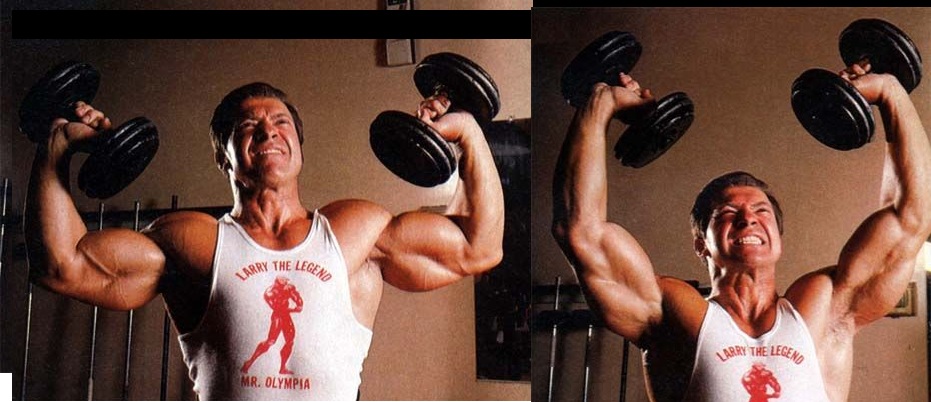
No shoulder pressing
Gironda was not a fan of shoulder pressing movements but rather advocated isolation movements like lateral raises for deltoid development.  There are, however, some press variations that he suggested, namely the Scott Press and the Bradford Press.

(a) The Scott dumbbell press
Larry Scott successfully used this exercise to bring up his deltoids to make up for his narrow structure. He maintained constant tension on the delts by not locking out at the top of the movement.
Fig 2: The Scott shoulder press
(b) The Bradford press
The Bradford press named after the lifter Jim Bradford is a modified version of a barbell press.  This exercise works the front and side deltoids and recruits the rear deltoids to some degree for stabilisation. Importantly, the weight need to be lower in this exercise (by about 10-20%) and  a slightly wider than shoulder grip is recommended. Start with the barbell resting on the collarbone as you would in a barbell millitary press. Then press the barbell until you reach just the top of the head, move the barbell over your hear and lower it behind your head until it touches the base of your neck. As a means of keeping constant tension on the delts the arms should never be extended completely. It is basically a back and forth movement with the barbell lifted just enough to clear the head. Do not move the head to make the movement easier, let the movement happen at the shoulder joint.  The video by T-Nation below demonstrates the proper Bradford Press technique.
The Gironda Lateral Raise technique
Gironda was very fond of the side lateral raise, an exercise that he recommended to perform either seated or standing. The seated lateral raise technique is illustrated in Figure 3 below and is as follows:
  • Sit at the end of a bench and maintain a slight forward lean. All four bells of both dumbbells should touch under the legs.
  • Raise the dumbbells while maintaining the slight forward bend position until the dumbbells reach head height. 
  • In this position the palms should be down and the knuckles up, meaning the rear bell should be higher than the forward bell, as if you are pouring water from a pitcher. This ensures that the lateral head does most of the work. Vince recommends 4 sets of 8-12 reps with about 30 seconds rest between sets.
  • The torso should not move throughout this exercise. Do not use the forward bent position as a means to use upper body momentum to help you lift heavy weights. I am sure that if you did this in Vince's gym the latter would have thrown you out of his gym.
    Fig 3: The seated lateral raise technique from the Vince Gironda Bulletin
    Fig 4: A custom-built equipment for maintaining a slight incline
    in standing side lateral raises. Gironda was known for his unique equipment
    Fig 5: The Iron Guru was always very attentive to form.
    Fig 6: Larry Scott demonstrating the side laterals
    Fig 7: Scott performing the seated version of the facing
    side lateral raise
    The Gironda dumbbell swings and high pulls
    The side swings is perhaps one of the best exercises to work several deltoid heads at the same time and a good means to prevent cheating.  Gironda's dumbbell swings work the side and anterior deltoids. To perform side swings, one arm moves in a traditional lateral raise motion while the other arm is moves up across the front of the body, tight to the torso, to keep continuous tension on the shoulder and help get a deeper contraction.
    Fig 8: Gironda performing the dumbbell swing and the high pull (described below)
    Barbell High pulls and upright rows.
    These two were Gironda's favourite exercises for the side deltoids.  Using a shoulder width grip recruits the side deltoid head to a greater degree. The execution of the High Pull is decribed in Fig 9. I believe there is a degree of trap involvement in this exercise. In the case of the barbell upright row the bar is kept closer to the body, as described in Fig 10.  Gironda credits the wide grip upright row/ pull component of cleans for the outstanding shoulders of weightlifters rather than the actual pressing movement.
    Fig 9: Gironda High Pull
    Fig 10: Execution guidelines for the Gironda barbell (wide grip) upright rows
    Tune in for more from in the "Iron Guru" series
    _______________________________________________________________________________

    ©,2013, Veeraj Goyaram, Bodybuilding Mauritius. Any reprinting in any type of media is prohibited.
    Disclaimer:
    The Content on this site is intended to be used for educational and entertainment purposes only. It is not intended to be and should not be interpreted as medical advice or a diagnosis of any health or fitness problem, condition or disease; or a recommendation for a specific test, doctor, care provider, procedure, treatment plan, product, or course of action. BODYBUILDING MAURITIUS is not a medical or healthcare provider and your use of this site does not create a doctor / patient relationship. We disclaim all responsibility for the professional qualifications and licensing of, and services provided by, any physician or other health providers posting on or otherwise referred to on this Site and/or any Third Party Site. Never disregard the medical advice of your physician or health professional, or delay in seeking such advice, because of something you read on this Site. We offer this Site AS IS and without any warranties.  Qualifications of author of article: Bachelor of Science (Honours) in Biology (Department of Biosciences, University of Mauritius) and Master of Science in Medicine in Exercise Molecular Biology/ Nutrition/ Type 2 diabetes (Research Unit for Exercise Science and Sports Medicine, University of Cape Town). Correspondence: vicgoyaram@gmail.com
    ________________________________________________________________________________


    YOU CAN'T WIN 'EM ALL


    In today's high speed culture, multitasking is a highly prized and sought after skill.  The advent of smart phones has made it so that at all times, we can be accomplishing another task, whether it be while driving, standing in line, or on the toilet.  Those who cannot multitask are viewed as slow, incompetent  weak and undesirable, whereas those that can aren't particularly rewarded for their ability, as it's become somewhat expected.  Yet, just like those people texting and driving, if you try to multitask when it comes to your training, you're just going to crash and burn.


    And you're probably an asshole, plus your blinker has been on for miles


    As appealing as it may be to be awesome at everything, you have to take a realistic look at yourself when it comes to training.  How great of an athlete are you?  Is it possible you have the genetic makeup to be great at many activities, or is it more probable that, if you have the capability to be great at all, it's only going to be at one thing?

    Go through your mental rolodex and think of how many athletes you know of that were ever at the professional level in two sports?  Right now, the only thing that comes to mind for me is Bo Jackson.


    Yes, I made a reference to Rolodex and Bo Jackson, I swear I am writing this in 2013


    On the other end of the spectrum, think about great athletes that have attempted to dabble in other sports, and the results that occurred.  As big of a fan as I am of Mariusz Pudzianowski, his foray into MMA demonstrated that he will need to undergo a vast amount of training to be able to compete at a reasonable level in his new sport.


    Don't get me wrong though.  I still wouldn't fight him


    Brian Siders, one of the strongest men in the world by powerlifting standards, had a very lackluster peformance in his World's Strongest Man debut as well.  And these are sports that value similar attributes in their respective athletes.  It gets even worse as you attempt to deviate to odder extremes.

    Think about it.  Professional athletes are genetic supermen that have trained their whole lives to excel athletically, yet these individuals still need to specialize.  Why is that?  Because very few people have the capacity to be great at many things, and the reality is, if you want to be great at anything, it's going to come at the expense of pursuing other physical goals.

    From a personal example, growing up, I wanted to be big and strong, and I also wanted to be a fighter.  In my mind, the two were equated, in that being big and strong would surely make me a great fighter, and being a great fighter would be the purest expression of strength.  In reality though, the goals contrasted.  My lifting would negatively impact my recovery from fight training, whereas my fight training would make me skinny from the energy I expended.  After years of training both goals, I was terrible at both of them.  Once I finally hung up the gloves and pursued strength training full time, my lifts took off, with me adding 140lbs to my deadlift and 30lbs to my bodyweight in a year.

    This isn't to say that you can't pursue multiple goals as an athlete, it just means you have to pick and choose the time to chase these goals.  If you try to train for powerlifting while engaging in boxing training and HIIT on your "off days", you're going to burn out quick and have no progress to show for it.  But if you periodize your training so that you have a phase where you are 100% dedicated to strength, then conditioning, then your sport, you will make massive gains in each endeavor.
    Related Posts Plugin for WordPress, Blogger...